
CheckRx: Designing Trust for Medicare Agents
Medicare agents spend their days keeping seniors out of the wrong plan. I spent mine making sure their tool did not slow them down.
ROLE
Product Designer
TEAM
3 Developers, 1 Designer
SKILLS
Concept Validation
Prototyping
UX/UI Design
Data-scraping
Product Research
CheckRx is an AI platform for Medicare agents, the people who spend their days helping seniors find the right plans, verify providers, and stay compliant with regulations that change every year. The problem is not that agents lack information. It is that the information lives everywhere at once: CMS databases, insurer portals, a dozen tabs open on the same screen.
My role was to understand how agents actually work, not how the product assumed they worked, and translate that into a product and marketing presence they would trust.
What follows covers two surfaces I designed: ANA, our general-purpose Medicare sales agent tool, and a proof of concept built specifically for UnitedHealthcare to demonstrate the platform's value to a single carrier.
Before designing anything, I shadowed over 50+ Medicare agents during live client calls and conducted interviews to mapped their workflows. What I found wasn't a technology problem, it was a cognitive load problem.
Agents weren't failing because they lacked tools. They were failing because every tool spoke a different language, lived in a different tab, and required a different mental model to use. The most telling moment came from an agent who said:
"Medicare is an ever-changing landscape. Having a tool that I know is updated with providers and everything I need would greatly reduce the amount of time I spend researching."
And then, more bluntly:
"Your platform has the potential to stop me from opening over 10 tabs a day."
That was the brief. Not 'build an AI assistant.' Build the one tab that replaces ten.
From the research, three things became clear about who we were designing for:
Agents are time-pressured and compliance-aware — every wrong answer to a senior is a liability.
They're deeply skeptical of new tech, especially AI, because they've been burned by tools that go stale
Trust is earned through accuracy and speed, not features
ANA: One tab that replaces ten.
While ANA serves any Medicare agent regardless of carrier, we built a separate proof of concept specifically for UnitedHealthcare. The goal was to demonstrate how CheckRx's data and AI layer could help a carrier's own team understand their competitive position, not just look up plans.
For my role, though it was primarily on the design side, I scraped for more data on the purpose of handling it from a UHC agent perspective. I found market analysis data through CMS' APIs to cover enrollment and plan data that we had already previously structured.
ANA: AI Powered Platform
Project Overview
The plan comparison tool starts with how agents actually begin a search. In interviews, I learned that agents do not all enter the same way. Some start with a ZIP code, some know the county, some already have a plan name from a client.
Drug coverage is where plans get personal. An agent's client does not care about a plan's star rating if their medication is not covered. The prescription search pulls from a live medication database, surfacing brand names, generics, and dosage variants so agents can match exactly what their client takes.
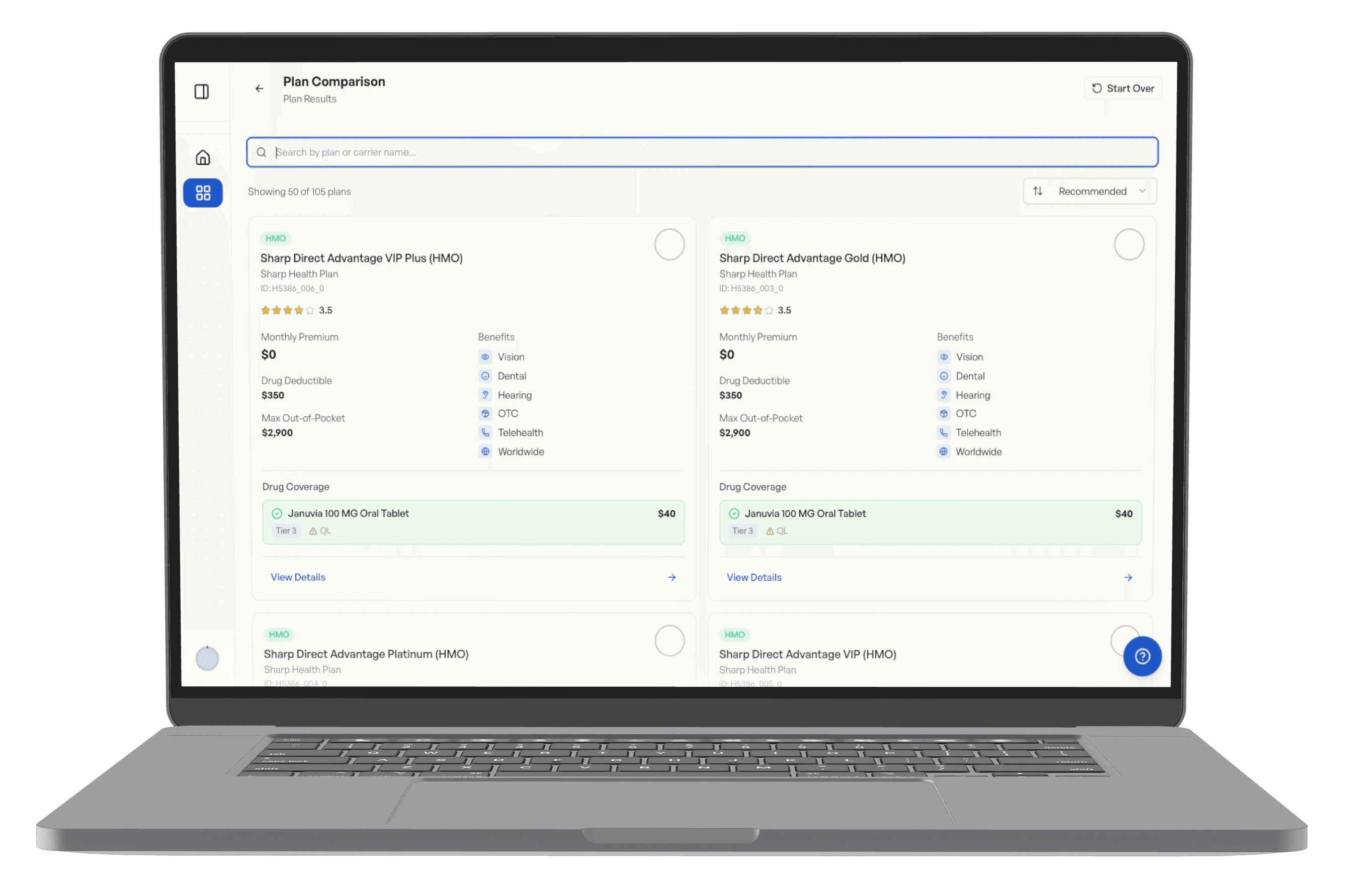
The results view was the most debated screen on the team. I pushed for side-by-side cards over a table because agents told me they compare plans the way they explain them to clients: one against another, not row by row.
Each card shows monthly premium, deductible, max out-of-pocket, supplemental benefits, and drug coverage inline so an agent can scan two plans in seconds and see exactly where they differ.
The drug coverage section is intentionally not hidden behind a click. In every interview, agents said verifying drug coverage was the single most time-consuming part of their workflow. Surfacing it directly on the card, with tier level and quantity limit flags visible, eliminated the extra step that used to cost them the most time. This is what brought agent research time from 45 minutes down to 10.
Proving the platform to a single carrier.
While ANA serves any Medicare agent regardless of carrier, we built a separate proof of concept specifically for UnitedHealthcare. The goal was to demonstrate how CheckRx's data and AI layer could help a carrier's own team understand their competitive position, not just look up plans.
For my role, though it was primarily on the design side, I scraped for more data on the purpose of handling it from a UHC agent perspective. I found market analysis data through CMS' APIs to cover enrollment and plan data that we had already previously structured.
I'd never built a product demo before. So I learned.
CheckRx needed a way to show what the platform does without exposing screens we were not ready to share publicly. I had Illustrator experience and knew SVG animation, but a full After Effects production was new territory.
What started as a product launch video became something more durable: a demo reel that captures the current platform state in a format flexible enough to share with Medicare agency partners before we are fully live.
Learning motion graphics mid-project was not comfortable, but it meant we had a real asset instead of a placeholder promise.


ANA reduced agent research time from 45 minutes to 10 by consolidating plan lookup, drug verification, and provider checks into a single interface informed by 50+ agent interviews. The UHC proof of concept translated that same research foundation into a carrier-facing tool and is now under review by UnitedHealthcare's team.
The product work continues. If you want to talk through the process, decisions, or outcomes in more depth, reach out anytime.